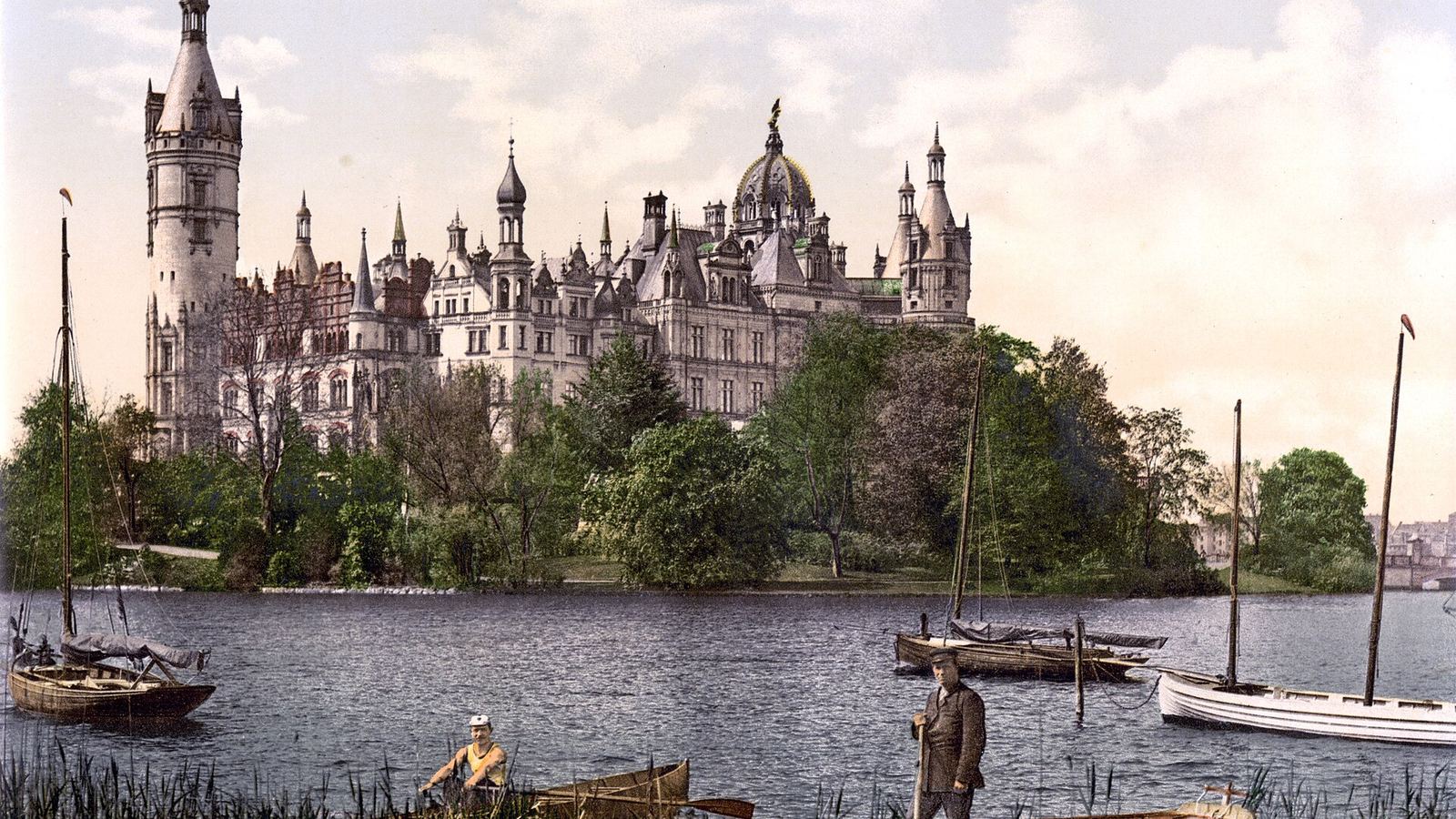
From Slavic fort to fairytale residence and parliament, with a house ghost to guard it
Few places in Germany have been continuously fortified, ruled and rebuilt for as long as the castle island at Schwerin. A Slavic fort, a medieval stronghold and a Renaissance palace all stood here before Grand Duke Friedrich Franz II created the romantic castle you see today.
Its silhouette of towers, turrets and a gilded dome has earned it the nickname "Neuschwanstein of the North", though it was completed before Neuschwanstein was even begun.
The first record of a fortress on the island in Lake Schwerin, held by the Obotrites, a Slavic people.
Facing an attack by Henry the Lion, the Obotrite prince Niklot burns the fort. The Germans build a new one, and the city of Schwerin is founded.
Niklot's son Pribislav receives much of the land, founding the line that will rule Mecklenburg until 1918.
Niklot's descendants become Dukes of Mecklenburg and move their seat to Schwerin.
Duke John Albert I turns the fort into a palace, decorated with terracotta from Lübeck, and rebuilds the castle church (1560–1563).
The court leaves for Ludwigslust Palace, and Schwerin Castle falls quiet for eighty years.
Grand Duke Friedrich Franz II has the castle rebuilt in romantic historicist style, inspired by Chambord, by Demmler, Semper, Stüler and Zwirner. The Petermännchen sculpture by Heinrich Petters dates from 1856.
In December, fire destroys about a third of the castle.
Revolution forces the last grand duke to abdicate. The castle becomes state property.
After a time as a museum and the state parliament, the castle becomes a college for kindergarten teachers.
The Landtag of the new state of Mecklenburg-Vorpommern moves into the castle.
The Schwerin Residence Ensemble is inscribed on the UNESCO World Heritage List.
When Friedrich Franz II halted his predecessor's plans in favour of a complete rebuilding, he wanted a residence worthy of a grand duke. The new castle drew on the French Renaissance châteaux of the Loire, above all Chambord, wrapped around the older buildings on the island.
Georg Adolph Demmler, Gottfried Semper, Friedrich August Stüler and Ernst Friedrich Zwirner all shaped it. Stüler added the gilded cupola and the equestrian statue of Niklot over the main portal.
Above the main portal, the Obotrite prince Niklot rides out on horseback, a reminder that the grand dukes traced their line back to the Slavic rulers of the island.
The fire of December 1913 destroyed about a third of the castle. Restoration continued for decades; most of the work was complete by 2019.
Every great castle has a ghost, and Schwerin's is the Petermännchen: a small house spirit said to roam the passages at night, guarding the castle and its treasures, and playing tricks on anyone with bad intentions.
The sculptor Heinrich Petters carved a statue of him in 1856, during the great rebuilding. Today he is Schwerin's unofficial mascot, and you'll find him on the city's pedestrian traffic lights.
Look for the Petermännchen on the traffic lights near the castle, one of Schwerin's favourite photo spots.
The private walking tour starts at the castle and covers its legends. See the tour →
Castle museum open Tuesday to Sunday. €13, free under 18.